


In a bit of a fankle (meeting Gilbert)
Originally written JUNE 7, 2023
fankle: a Scottish expression that means a state of confusion, disorder, or entanglement. It is often used to describe a situation where things have become jumbled or tangled, both physically and metaphorically. When someone is “in a fankle,” they might be experiencing difficulties or complications that make it hard for them to navigate or resolve the situation smoothly. It’s similar to being in a muddle or a mess.
The consultant’s words confirmed my worst fears:: ‘David, thank you for coming in today. Your CT brain scan shows that you have a brain tumour’. And without meaning to be melodramatic, it felt like my world had fallen apart.
I’m lucky that I have never really suffered headaches, save for the odd hangover or times with a big pile of ‘Docman’ clinical letters/results to wade through on a computer screen. But in March 2023 I started noticing some persistent headaches when I got up in the morning. Over subsequent weeks these headaches became worse on moving around or when standing up with my daughter in my arms. I am a GP. My medical knowledge led me to recognise that these were potential ‘red flag’ symptoms – symptoms that can represent something serious.
I discussed this with my GP. She agreed that I should be referred for an urgent CT brain scan, and suggested that I see an optician. This I did within a few days – and again I was pleased with excellent attention to my situation, including testing of my visual fields. I hadn’t noticed any issue with my vision, but the visual field testing detected a homonymous quadrantanopia (when part of your vision becomes dysfunctional) – and this can be an indication of a problem in the brain tissue, for example a stroke or a tumour.
The following weekend, when I was at RugbyTots with my wife and my daughter, I noticed that my headache had become even worse on moving around. I became more concerned about this and we went to our local A&E for further assessment.Instead of further waiting for a CT scan, I ended up with a CT brain scan there and then, and the news that was going to change my life.
And so it began. I was admitted overnight to the neurosurgical ward, and I had further scans the next morning. I was thinking, constantly, about the potential impact of all of this on my family, all whilst witnessing some extremely reassuring high-quality medicine and skill around me from nurses, doctors and others involved in my care. I was told I had a glioma, that the team thought it looked ‘low grade’, but that the journey to learn more about the potential role of surgery, chemotherapy and radiotherapy was going to take some time to develop. The first major and immediate changes were being unable to drive (for at least a year), and 6 months – likely more – of being unable to work.
That night, I found myself overwhelmed with thoughts, worry, and a similarly overwhelming need to plan and fix my way out of this. At 6am the next morning, in the neurosurgical ward, I had soaked the bedsheets with tears of panic and fear for what this meant for all the plans and dreams I had for my family and others. But I also quickly learned that there were going to be some very skilled and expert clinicians around me to work out what treatments and advice I would need from now. I started experiencing incredible acts of kindness from close family, friends and others which combined to give me so much hope and reassurance that I would be supported to take on whatever challenges this situation would throw at us.
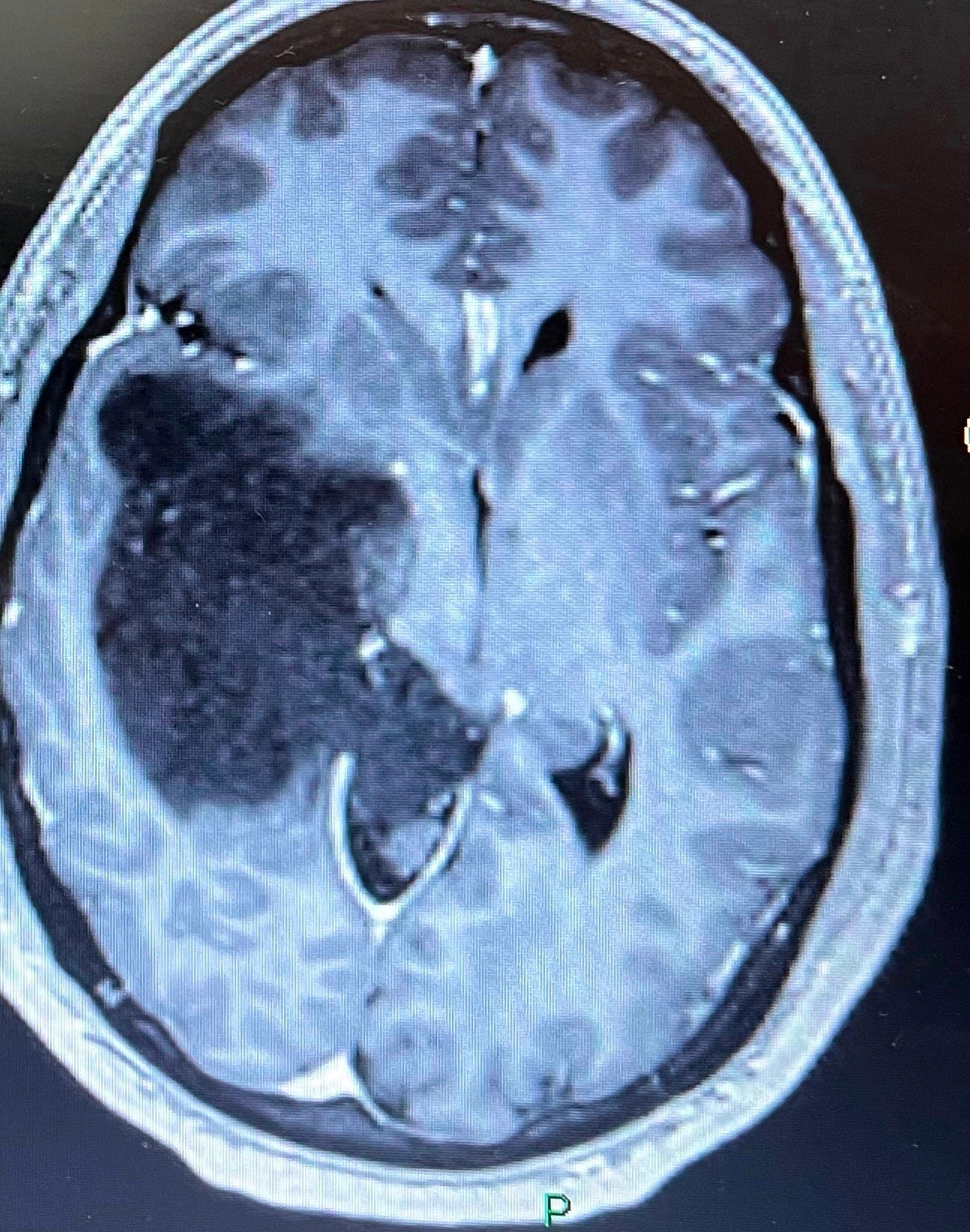
The scans showed a large mass sitting in my brain. And so in the same way that I encourage our daughter to name the spiders, woodlice and flies in our house and garden, I opted to name this new presence in my brain: Gilbert the Glioma